
Online dating has a fundamental trust problem.
When two people meet through a dating app, neither initially knows with certainty who is on the other side of the screen. Profile photos can be misleading, ages can be falsified, fake accounts can be created, and scammers can build convincing identities using photographs taken from elsewhere online.
The obvious solution might seem simple: require everyone joining a dating app to prove their identity with a passport, driving licence or other government-issued ID.
Surprisingly, that is not how most major dating apps operate.
A comparison of verification systems used by major dating and matchmaking platforms shows that compulsory government-ID verification at signup remains unusual.
Instead, the industry is increasingly adopting a layered approach:
Account verification → age assurance → selfie or face verification → optional or risk-based government ID verification.
That distinction matters because dating platforms often use the word “verification” for processes that establish very different things.
What Does “Verified” Actually Mean?
Before comparing dating apps, it helps to separate four common forms of verification.
Phone or Email Verification
The app sends an OTP, confirmation link or similar challenge to an email address or phone number.
This establishes that someone controls that email account or telephone number.
It does not prove their real name, age or that their photographs genuinely belong to them.
Selfie or Photo Verification
The user takes a live photograph or video selfie that can be compared with their profile photographs.
This is considerably more useful for combating stolen photographs, impersonation and catfishing.
However, matching someone’s face with their profile photographs still doesn’t necessarily establish their legal identity.
Age Assurance
Age assurance attempts to determine whether somebody meets the minimum age required to use the service.
Depending on the platform, this can involve facial age estimation, a video selfie, third-party age-assurance technology or government ID.
This is becoming particularly important for dating platforms operating in the UK.
Government ID Verification
This is a stronger form of verification involving documents such as a passport, driving licence or national identity card.
The process can potentially establish a person’s date of birth, photograph and identity. Some systems combine the document with a live selfie to establish that the person presenting the ID is also its owner.
Government-ID verification therefore provides a substantially stronger identity signal, but it also creates greater signup friction and additional privacy and data-security considerations.
Which Dating Apps Require ID Verification?
The differences become much clearer when the major platforms are compared directly.
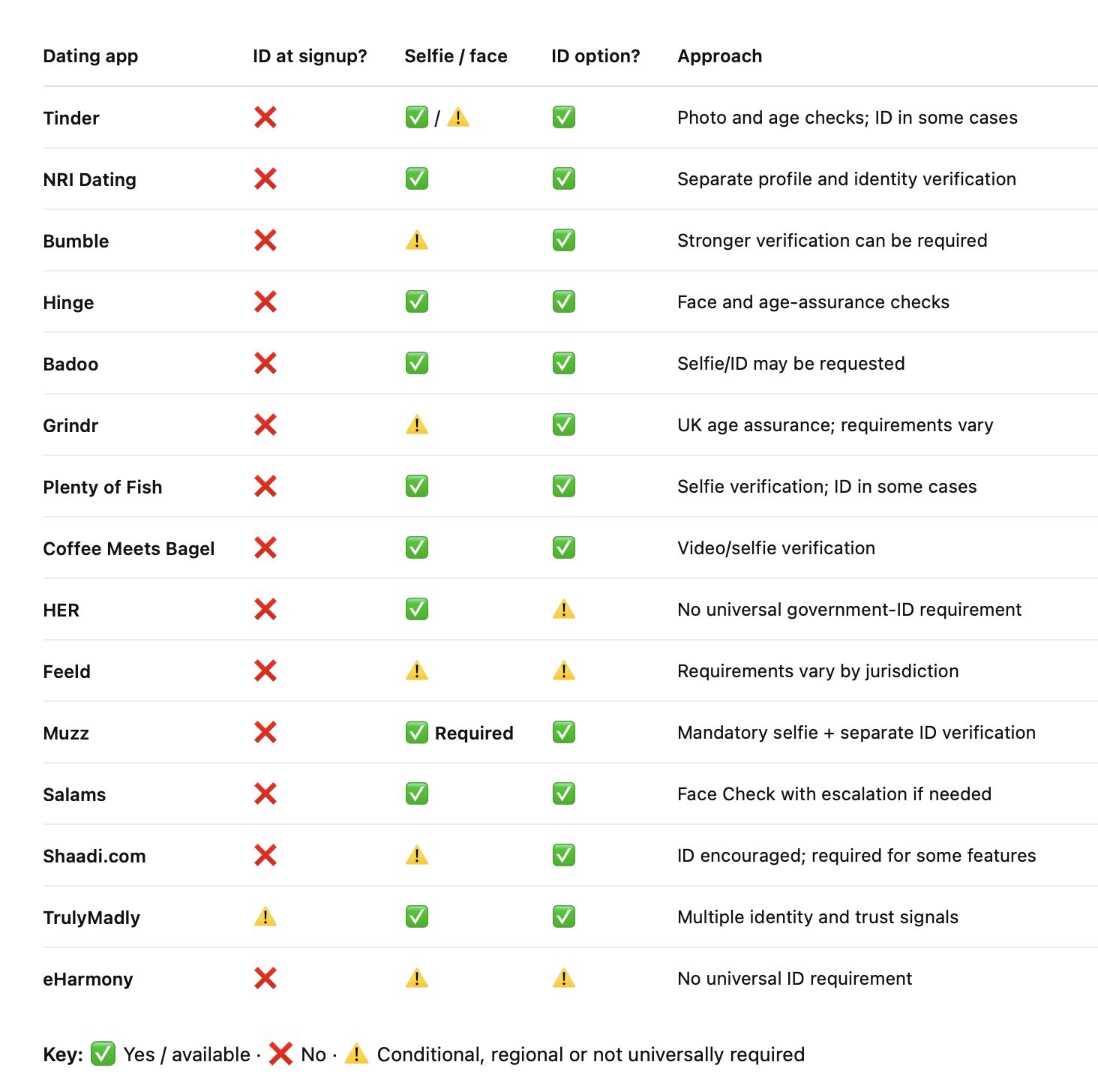
The most striking finding is straightforward:
Major dating apps generally do not require every user to submit government ID simply to create an account.
That doesn’t mean identity verification is disappearing. In fact, the opposite is happening.
Dating platforms are introducing more verification, but separating it into different levels.
Why Don’t Dating Apps Require ID From Everyone?
Universal government-ID verification initially sounds attractive.
Fake accounts could become harder to create. Underage users could be easier to detect. Previously banned users might have more difficulty returning. Romance scammers would face another obstacle.
But compulsory ID verification introduces significant trade-offs.
Signup Friction
Dating apps depend heavily on users completing onboarding.
Entering an email address, verifying a phone number and uploading photographs is relatively familiar.
Being asked to photograph a passport before even seeing who is on the platform is a much bigger commitment.
Every additional requirement creates another opportunity for a legitimate prospective user to abandon registration.
Privacy
Dating profiles can contain unusually personal information, including relationship intentions, religion, location, photographs, dating preferences and private conversations.
Some people understandably hesitate to connect that information directly with their passport or driving licence unless there is a strong reason to do so.
This concern can be particularly significant for dating platforms serving communities where users may want greater control over the visibility of their photographs or dating activity.
Data Security
Government identification is highly sensitive.
Collecting it creates important questions:
How long is the document retained?
Who processes it?
Is the original image stored?
Can employees access it?
Is biometric information created?
When is the information deleted?
What happens if the system is compromised?
A dating service that doesn’t need to retain government ID can avoid creating some of this risk in the first place.
International Complexity
Dating platforms can operate across dozens of countries.
There is no universal identity document.
One country may primarily use national ID cards, while another relies on driving licences and passports. Documents use different languages, formats and security features.
Reliable worldwide government-ID verification is therefore much more complicated than simply adding an “Upload ID” field.
Muzz Shows an Interesting Alternative
One of the more interesting approaches comes from Muzz.
Rather than making government ID compulsory for everyone at initial signup, Muzz makes selfie verification compulsory.
This allows the platform to establish that a real person corresponds with the photographs associated with the profile without requiring every member to immediately provide a passport or driving licence.
Government-ID verification can then exist as a stronger, separate trust level.
This creates an important distinction:
Photo/Selfie Verified
The person completing the verification appears to correspond with the person shown in the profile.
ID Verified
The person has completed a stronger process involving recognised identification.
These two badges communicate different things and arguably shouldn’t be combined into one generic “Verified” status.
Verification Can Work With Private or Blurred Photos
Another important point is that verification doesn’t necessarily require profile photographs to be publicly visible.
A dating platform can privately verify someone’s face while separately allowing that person to control who can see their photographs.
This distinction is particularly relevant to dating and matrimonial communities where privacy is important.
The platform itself can potentially know:
“We have verified that this person corresponds with the photographs supplied.”
while other users initially see a blurred or restricted version of those photographs.
Verification and photographic privacy therefore don’t have to be opposing ideas.
The Rise of Age Assurance in the UK
One of the biggest changes affecting dating apps is the increasing importance of age assurance.
Age assurance is subtly different from identity verification.
A dating service doesn’t necessarily need to establish:
“This is John Smith, born on 17 March 1996.”
It may simply need sufficient confidence that:
“This person is an adult and meets the age requirement for this service.”
That distinction allows more privacy-preserving approaches.
A user might take a live selfie. Technology can estimate whether the person is above the required age threshold. Government identification can then become a fallback when age cannot be established with sufficient confidence.
Major platforms including Tinder, Hinge and Grindr have incorporated stronger age-assurance mechanisms into their UK operations.
This could become increasingly important across the wider dating industry.
The Emerging Verification Model
Looking across the major platforms reveals a fairly clear direction.
Rather than performing one enormous identity check during registration, dating apps are creating layers of trust.
Level 1: Account Verification
Verify the user’s email address and/or telephone number.
This establishes control over the account’s primary communication channel.
Level 2: Age Assurance
Establish that the person satisfies the platform’s minimum age requirement.
This can use age-estimation or other age-assurance technology rather than necessarily establishing the person’s complete identity.
Level 3: Selfie Verification
Ask the user to take a live selfie or short video and compare it with their profile photographs.
This helps combat stolen photographs, impersonation and catfishing.
Level 4: Government ID Verification
Allow or require stronger verification through a passport, driving licence or other recognised identity document.
Successfully verified members can receive a clearly differentiated identity-verification badge.
Level 5: Risk-Based Verification
Require stronger verification when suspicious circumstances arise.
Possible triggers include:
- reports of impersonation;
- suspected fake photographs;
- questionable age;
- repeated account creation;
- attempts to evade previous enforcement;
- unusual behaviour;
- suspected fraud.
This allows platforms to concentrate their strongest checks where they are most useful instead of forcing every legitimate user through maximum-friction verification.
A Verification Badge Should Say What Was Verified
There is another important lesson from comparing these platforms.
The word “Verified” by itself is becoming too ambiguous.
Consider two users.
One takes a live selfie that matches their profile photographs.
Another provides a passport and completes a live facial comparison against the passport photograph.
Calling both users simply “Verified” hides a meaningful difference.
Dating platforms can communicate trust more clearly with separate indicators such as:
✓ Photo Verified
✓ ID Verified
The first means that the platform has established a connection between the live person and their profile photographs.
The second means the person has successfully completed a stronger identity-document verification process.
Even then, platforms need to avoid implying more than verification actually proves.
An ID-verified person isn’t necessarily honest, trustworthy, single or genuinely looking for a relationship.
The badge establishes that a particular verification process was successfully completed.
Nothing more.
Verification Cannot Eliminate Dating Scams
Even mandatory government ID couldn’t eliminate every dating scam.
A scammer can use their genuine identity.
A verified person can lie about their relationship status.
Someone can misrepresent their occupation, income or intentions.
A person who passes identity verification can still behave abusively.
And a genuine user can attempt to move another person away from the dating platform before committing fraud.
Verification therefore works best as one component of a wider trust-and-safety system.
Other measures can include:
- automated scam detection;
- behavioural analysis;
- duplicate-account detection;
- block and report systems;
- human moderation;
- suspicious-link detection;
- payment-fraud monitoring;
- device-level abuse detection;
- warnings about moving conversations off-platform;
- profile moderation;
- enforcement against previously banned users.
Identity verification raises the cost of abuse. It doesn’t make abuse impossible.
Is Mandatory Government ID the Future of Dating Apps?
Current industry practices suggest something more nuanced.
Dating apps are clearly moving toward more verification, but that doesn’t necessarily mean they are moving toward a world where everyone must provide a passport before creating a profile.
The emerging approach is progressive verification.
Users encounter stronger verification when the platform, jurisdiction, feature or circumstances require it.
That allows dating services to balance several competing priorities:
Safety: reducing fake profiles, impersonation, underage access and fraud.
Privacy: avoiding unnecessary collection of highly sensitive identity documents.
Conversion: preventing legitimate users from abandoning registration because onboarding feels excessively intrusive.
Regulation: satisfying increasingly sophisticated age-assurance and online-safety requirements.
Trust: giving users understandable signals about the people they meet.
The future may therefore be less about one universal “Verified” badge and more about a verification ladder:
Phone Verified → Age Checked → Photo Verified → ID Verified
Each level establishes something different.
The Bottom Line
The comparison reveals a surprisingly consistent pattern.
Most major dating apps do not require every user to submit government-issued ID simply to sign up.
Tinder, NRI Dating, Bumble, Hinge, Badoo, Grindr, Plenty of Fish, Coffee Meets Bagel, HER, Feeld, Muzz, Salams, Shaadi.com and eHarmony all demonstrate, in different ways, that verification doesn’t have to mean universally demanding passports or driving licences at the registration screen.
Instead, the dating industry is developing layered verification systems.
One particularly significant development is the growing use of selfie, face and age verification without universal government-ID collection.
This can provide meaningful protection against fake profiles and underage access while limiting the amount of highly sensitive personal information collected from ordinary users.
Government ID can then provide a higher level of assurance for users who choose it, features that require it, or accounts where stronger verification becomes necessary.
Ultimately, the important question for dating platforms is no longer simply:
“Should users be verified?”
The more useful questions are:
What exactly needs to be verified?
When does it need to be verified?
What is the minimum personal information necessary to establish it?
And what should another user reasonably conclude when they see a verification badge?
Getting those distinctions right may be far more valuable than simply forcing every new user to upload an identity document.

Liz
UK-based writer covering modern dating, relationships and dating apps.
0 Comments