
For generations, finding a partner in many Indian families began with something remarkably similar to a résumé.
Name. Age. Height. Education. Profession. Family background. Religion. Community. Sometimes caste, horoscope, complexion, salary and an carefully selected photograph.
The marriage biodata reduced an enormous life decision to a page of facts that could be passed between relatives, family friends, marriage bureaus and prospective families.
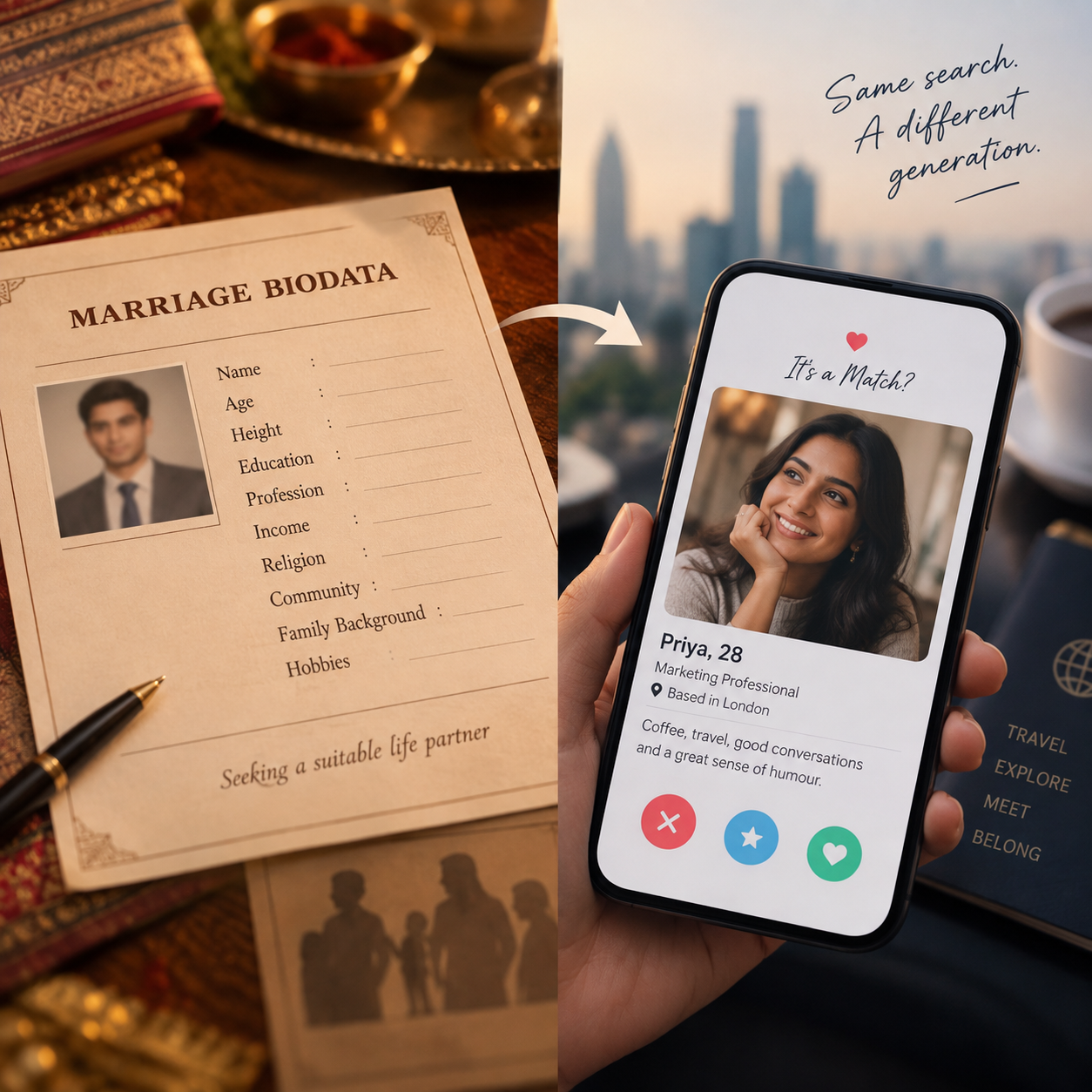 Today, the same search might begin very differently.
Someone in London opens a dating app during the commute home. An Indian professional in Dubai adjusts their preferences to meet people nearby. A second-generation Indian in Toronto looks for someone who understands their cultural background without necessarily sharing their religion or mother tongue. Someone else asks an AI-powered matching system to find people who fit a description of the relationship they want.
The biodata hasn’t completely disappeared.
Neither has family matchmaking.
Instead, Indian and NRI dating has developed into a complicated mixture of the old and the new: family introductions, matrimonial platforms, dating apps, social media, algorithms, AI and individual choice all operating at the same time.
And perhaps the biggest change isn’t technological at all.
It is the gradual shift from “Who is suitable for marriage?” to “Who do I actually want to build a life with?”
The Traditional Biodata: Match the Families First
The traditional Indian matchmaking system wasn’t designed primarily around dating.
Its purpose was marriage.
That distinction matters.
In conventional arranged-marriage settings, romantic compatibility wasn’t necessarily ignored, but it existed within a much larger framework.
Families might consider:
- religion;
- caste or community;
- language;
- education;
- occupation;
- income;
- family reputation;
- location;
- horoscope compatibility;
- dietary preferences;
- and socioeconomic background.
The potential bride and groom were obviously central to the marriage, but they weren’t always the only decision-makers.
Marriage could also represent a relationship between two families.
From that perspective, biodata made perfect sense.
It allowed families to screen potential matches efficiently against characteristics they considered important before investing time in meetings and discussions.
But biodata had an obvious limitation.
It was excellent at describing someone’s credentials.
It wasn’t particularly good at describing the person.
A document could tell you where someone studied, but not whether they made you laugh.
It could tell you their salary, but not how they treated restaurant staff.
It could list their family background without revealing how they handled conflict, affection, jealousy, money or vulnerability.
The system answered:
“Does this person fit the criteria?”
Modern dating increasingly asks a different question:
“Do I actually like this person?”
Then Matrimonial Websites Put the Biodata Online
When Indian matchmaking moved onto the internet, the fundamental model initially changed much less than it appeared.
Sites such as Shaadi.com, BharatMatrimony and Jeevansathi transformed how prospective partners could be discovered.
Suddenly, families and individuals weren’t limited to relatives, community networks, newspaper matrimonial advertisements or local marriage bureaus.
Someone could search across cities, states and eventually countries.
For NRIs, this was particularly significant.
An Indian living in Britain, Canada, the United States, Australia or the Gulf could potentially search a vast pool of people with similar cultural backgrounds.
But early matrimonial websites largely digitised the biodata rather than replacing it.
Age became a filter.
Religion became a dropdown.
Education became searchable.
Profession became a field.
Community preferences could be selected.
Income became a range.
The marriage bureau had effectively become a database.
It was revolutionary technologically while remaining surprisingly traditional socially.
The NRI Changed the Matchmaking Equation
Migration added another layer of complexity.
For many NRIs, choosing a partner wasn’t simply about finding another Indian person.
The questions became more nuanced.
Do you want someone born in India or raised abroad?
Does speaking the same language matter?
How important is religion?
Would someone raised in Mumbai adapt to Manchester?
Would someone raised in California understand the expectations of a traditional Indian family?
Would either person be willing to relocate?
What happens when parents live thousands of miles away?
How much involvement should families have?
Suddenly, “Indian” wasn’t a sufficiently precise description of compatibility.
Two people could share the same ethnicity and still have completely different ideas about dating, marriage, gender roles, independence, money, children and family obligations.
Diaspora life created identities that couldn’t always be captured by the traditional biodata.
Someone could be deeply connected to Indian culture while having little interest in caste.
Another person might be completely comfortable dating before marriage while still wanting a partner who understands Diwali, Indian food and family gatherings.
Someone else might want an arranged introduction—but insist on making the final decision entirely independently.
The distinction between traditional and modern stopped being particularly useful.
People became both.
Dating Apps Changed the Starting Point
The arrival of mainstream dating apps changed something more fundamental.
Matrimonial platforms generally begin with the assumption:
You are here to find a spouse.
Dating apps begin with:
You are here to meet someone.
What happens afterwards is negotiable.
Tinder popularised rapid, profile-led discovery.
Bumble changed aspects of how conversations could begin.
Hinge positioned itself more explicitly around relationships.
Platforms designed for South Asian audiences attempted to combine modern dating mechanics with cultural preferences.
NRI-focused services have pushed this further by recognising that diaspora dating has its own geography, identity and relationship-intention problems.
The key change was sequence.
Traditional matchmaking often worked roughly like this:
Eligibility → family compatibility → introduction → personal compatibility → marriage
Modern dating frequently reverses it:
Attraction → conversation → dating → compatibility → relationship → perhaps marriage
That is an enormous cultural shift.
Dating Before Marriage Became the Evaluation Process
In the traditional model, marriage could be the beginning of deeply getting to know your partner.
For many younger Indians and NRIs, dating is now the process through which they decide whether marriage should happen at all.
That means compatibility has expanded far beyond biodata.
People want to know:
Can we communicate?
Do we have fun together?
Are we sexually compatible?
How do we disagree?
Do our lifestyles fit?
How do we think about money?
Do we both want children?
What are our careers likely to demand?
How involved will our parents be?
Would either of us relocate?
How do we divide responsibilities?
What does commitment mean to each of us?
These questions are harder to turn into checkboxes.
And perhaps they should be.
From Parents Choosing to Parents Advising
One of the biggest changes in contemporary Indian matchmaking isn’t necessarily the disappearance of family involvement.
It is the change in the family’s role.
In many modern families, parents may still introduce potential partners, discuss backgrounds and offer opinions.
But increasingly, the individuals themselves expect to decide whether the relationship progresses.
This has created an interesting hybrid.
A mother might discover a profile.
Her daughter might then speak to the person privately.
They might exchange numbers.
They may date for several months.
The families might meet later.
Eventually, the couple—not their parents—decide whether they want to marry.
Is that arranged marriage?
Dating?
Family-assisted dating?
Perhaps the label no longer matters.
The boundaries have blurred.
The Biodata Hasn’t Disappeared. It Became Your Profile.
There is a delicious irony in modern dating.
We sometimes talk about biodata as though it belonged to an ancient era.
But what exactly is a dating profile?
Name.
Age.
Photographs.
Location.
Job.
Education.
Height.
Interests.
Religion.
Relationship intentions.
Lifestyle.
The biodata didn’t die.
We redesigned it and started carrying it in our pockets.
There is, however, an important difference.
Traditional biodata primarily communicated suitability.
Dating profiles try to communicate personality.
A prompt about your worst cooking disaster may reveal more about your sense of humour than a line saying “MBA, 5’10”, vegetarian”.
A photograph travelling through Vietnam tells a different story from a studio portrait selected for prospective in-laws.
Modern profiles don’t merely ask:
“Am I eligible?”
They ask:
“Would you find me interesting?”
But Have We Really Escaped the Checklist?
Not entirely.
Dating apps promised freedom from rigid matchmaking criteria.
Then we created filters.
Age.
Height.
Distance.
Education.
Religion.
Lifestyle.
Politics.
Children.
Smoking.
Drinking.
Relationship goals.
And for culturally focused dating services, perhaps language, community or country of origin as well.
The checklist survived.
It simply became personalised.
This creates one of the great contradictions of modern dating.
People say they want chemistry and spontaneity while simultaneously applying increasingly precise filters to determine who is allowed to appear on their screen.
The old system asked families to define the ideal match.
The new system asks us to do it ourselves.
We may discover that we’re just as demanding.
The Paradox of Too Much Choice
Traditional matchmaking suffered from too little choice.
Modern dating can suffer from too much.
When your potential dating pool consisted of introductions from relatives and local community networks, compatible people could be difficult to find.
Dating apps theoretically give access to thousands.
That sounds unquestionably better.
Until choice itself becomes the problem.
A perfectly promising person can begin to feel temporary because another profile is always waiting.
Maybe someone more attractive is three swipes away.
Someone more successful.
Someone taller.
Someone funnier.
Someone who lives five miles closer.
Someone whose parents come from the same region.
Someone who ticks one more box.
Dating technology solved the scarcity problem and created an abundance problem.
The challenge is no longer simply finding people.
It’s knowing when to stop searching.
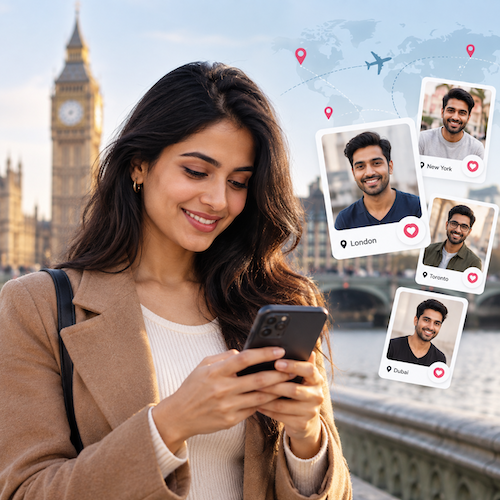
NRI Dating Has an Additional Problem: Geography
For diaspora communities, a huge online dating pool can be deceptive.
There may be millions of people around the world who broadly fit your cultural preferences.
That doesn’t mean many of them live near you.
A British Indian living in London may find someone highly compatible in Toronto.
Someone in New York connects brilliantly with a person in Dubai.
An Australian NRI meets someone in Singapore.
Technology has eliminated the introduction problem.
It hasn’t eliminated the Atlantic Ocean.
For NRIs seeking culturally compatible partners, modern dating therefore creates an unusual trade-off:
Expand your search and improve cultural compatibility, but potentially make geographic compatibility worse.
Eventually, someone has to answer the deeply unromantic question:
Who’s moving?
Love Now Has an Immigration Department
This is something ordinary dating advice often ignores.
For NRIs, relationships can involve immigration status, work visas, permanent residency, citizenship and sponsorship.
A relationship between two people in different countries may eventually require one person to leave behind a job, home, friends and established life.
Even people already living in the same country may have very different levels of immigration security.
These aren’t romantic questions.
But they become relationship questions.
Modern NRI dating isn’t only about emotional compatibility.
Sometimes it’s about whether two lives can practically exist in the same country.
Caste, Community and Religion Haven’t Simply Vanished
One tempting narrative says younger generations abandoned the traditional criteria of their parents.
Reality is more complicated.
Religion remains important to many people.
Language matters to some.
Community matters to others.
Caste remains relevant within parts of Indian matchmaking, even when younger people reject it personally.
At the same time, many Indians and NRIs increasingly prioritise characteristics such as personality, education, emotional compatibility, shared values and lifestyle.
Modern dating hasn’t replaced one universal set of priorities with another.
It has made those priorities individual choices.
One person may strongly prefer marrying within their religion while caring nothing about caste.
Another may happily date across religions but want someone who speaks their mother tongue.
Another may consider none of these things important.
That’s arguably the defining feature of contemporary matchmaking:
There is no longer one accepted formula.
The Rise of Relationship Intentions
Perhaps one of the most useful developments in modern dating is something matrimonial platforms always understood:
People need to know why the other person is there.
The difference is that today’s answer isn’t automatically “marriage”.
Someone might want:
- casual dating;
- friendship;
- a serious relationship;
- a life partner;
- marriage;
- or simply to meet people and see what develops.
This flexibility is liberating.
It can also create confusion.
Two people can be extremely compatible while wanting completely different outcomes.
No matching algorithm can solve that contradiction.
Someone seeking marriage and someone seeking something casual aren’t a poor algorithmic match.
They’re simply looking for different things.
Where AI Enters the Dating Story
We are now entering another stage.
The first generation of digital matchmaking gave us searchable databases.
The second gave us swiping and recommendation algorithms.
The next may increasingly involve artificial intelligence.
Instead of manually choosing twenty filters, someone might simply describe what they want:
“I’d like to meet an Indian woman in Britain who wants a serious relationship, values family but is fairly independent, enjoys travelling and would eventually like children.”
An AI system can interpret meaning rather than merely matching database fields.
Future systems may potentially learn from behaviour as well.
Who do you actually talk to?
Which conversations continue?
Which profiles do you repeatedly ignore despite claiming that they match your preferences?
What characteristics appear in your successful connections?
This raises fascinating possibilities.
It also raises uncomfortable questions.
Can an Algorithm Understand Chemistry?
Dating platforms can know an extraordinary amount about us.
Our age.
Location.
Preferences.
Education.
Interests.
Swiping behaviour.
Who we message.
Potentially how long conversations last.
AI may become increasingly sophisticated at detecting patterns in that information.
But attraction contains things that are remarkably difficult to quantify.
The way someone laughs.
The atmosphere when you sit together.
Their smell.
The pause before a joke.
The way they treat a stranger.
The peculiar feeling that makes conversation effortless with one person and exhausting with another.
An algorithm may become exceptionally good at deciding who deserves an introduction.
That doesn’t mean it can decide who deserves your heart.
The AI-Written Profile Problem
AI also creates a strange authenticity problem.
People can already use generative AI to write dating bios, improve photographs, suggest opening messages and compose replies.
Used lightly, this isn’t necessarily different from asking a friend:
“Does this profile sound okay?”
But where is the boundary?
If AI writes your biography, chooses your photographs, writes your opening line and tells you how to respond, who is the other person actually getting to know?
Dating has always involved presentation.
People wear their better clothes on a first date.
They choose flattering photographs.
They try to say interesting things.
AI simply makes impression management dramatically more powerful.
The challenge for the next generation of dating platforms may therefore be the opposite of the previous generation.
Yesterday’s problem was:
How do we find more people?
Tomorrow’s may be:
How do we know the person we’re meeting is real?
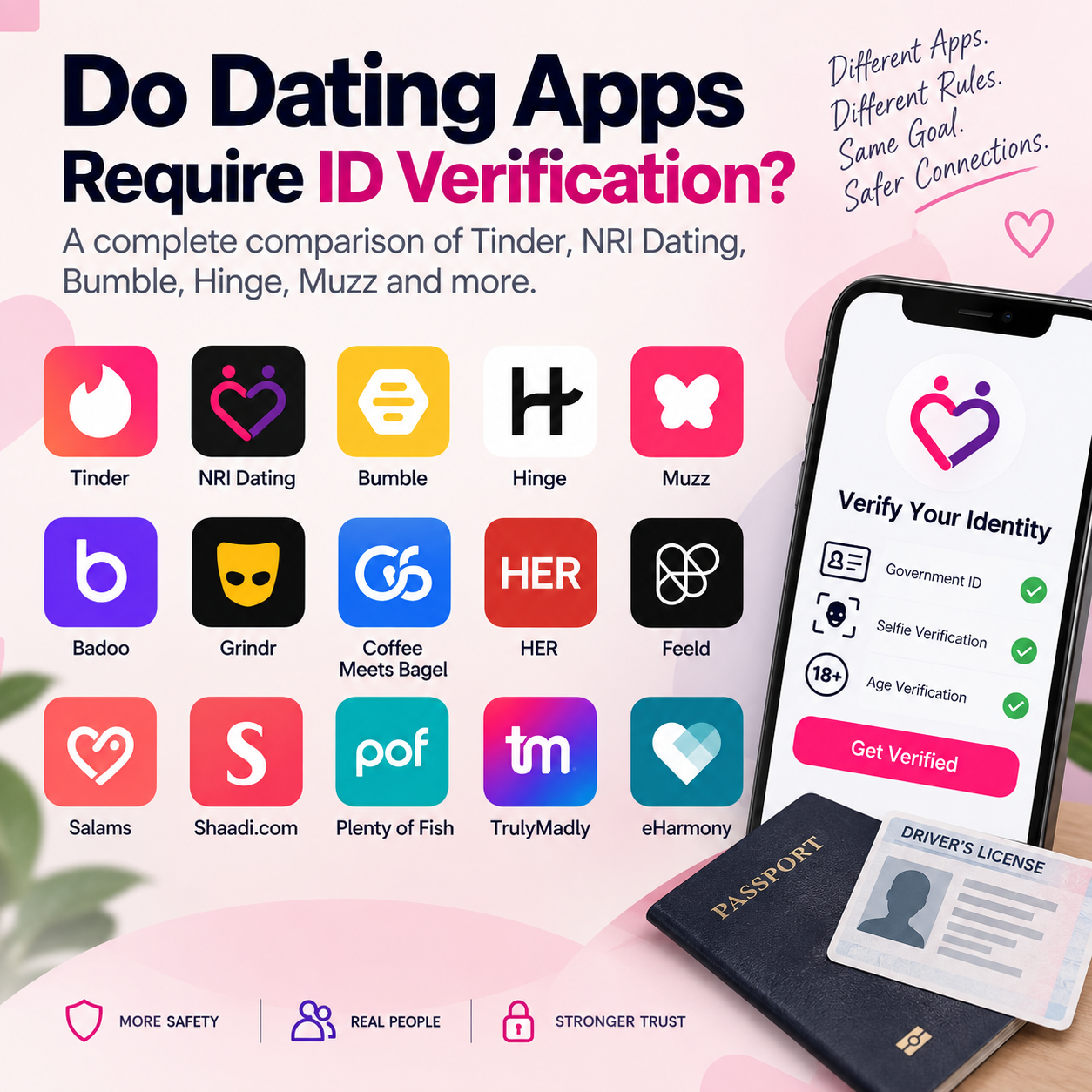
Verification May Become More Important Than Matching
As AI-generated images, automated conversations and sophisticated scams improve, identity verification is likely to become increasingly valuable.
Users may care less about whether an app has ten million profiles and more about whether the person they’re speaking to genuinely exists.
Photo verification.
Phone verification.
Identity checks.
Fraud detection.
Behavioural signals.
Privacy controls.
These aren’t glamorous dating features.
But trust may become one of the most valuable features a dating platform can provide.
A perfect match is worthless if the person isn’t real.
What Traditional Matchmaking Got Right
Modern dating shouldn’t automatically dismiss everything that came before it.
Traditional matchmaking understood several things rather well.
Marriage is bigger than attraction
Chemistry matters.
But long-term relationships also involve finances, families, children, lifestyle, responsibilities and values.
Intentions matter
Traditional matrimonial introductions rarely suffered from uncertainty about why everyone was there.
Marriage was the objective.
Modern dating’s flexibility is valuable, but ambiguity can create its own problems.
Compatibility exists outside romance
How two people approach family, money, career and responsibility can matter enormously after the honeymoon period.
Social context matters
Relationships don’t exist entirely in isolation.
Friends, families and communities can influence a couple’s life, particularly in cultures where family relationships remain close.
Modern dating gained something valuable by putting individual choice first.
It doesn’t need to throw away everything else.
What Traditional Matchmaking Got Wrong
There are equally important reasons younger generations challenged the old model.
A person is more than their credentials
Education, income, height, caste and profession cannot tell you whether two people will enjoy sharing a life.
Family approval isn’t personal compatibility
Two families can be delighted with a match while the people getting married have little emotional connection.
Social pressure can distort consent
Marriage should be freely chosen.
Pressure from family, community or fear of social judgement can make it difficult for someone to express what they actually want.
Compatibility cannot always be predicted on paper
Some extraordinary relationships make very little sense as a spreadsheet.
People are messy.
Love is worse.
That’s part of the point.
Pros of Modern Indian and NRI Dating
More personal choice
People have far greater control over whom they meet and whether a relationship progresses.
A larger dating pool
Technology allows people to connect beyond family networks, neighbourhoods and local communities.
For NRIs, that can be transformative.
Time to establish compatibility
Dating gives couples an opportunity to understand each other before making major commitments.
More freedom across traditional boundaries
People can more easily meet outside their immediate religion, language, caste, community or social circle if they choose to.
Better matching by lifestyle
Modern platforms can account for factors that traditional biodata often ignored, including hobbies, personality, relationship intentions and lifestyle preferences.
Greater independence from family networks
Someone doesn’t need an auntie who knows another auntie who happens to know somebody’s son.
Your dating life can actually belong to you.
Cons of Modern Indian and NRI Dating
Choice overload
More options don’t necessarily make choosing easier.
Disposable dating
When alternatives always appear available, people can become quicker to abandon potentially good connections.
Misrepresentation
Profiles can exaggerate lifestyles, appearances, intentions and achievements.
AI may make this even easier.
Ghosting
Digital communication makes disappearing from someone’s life remarkably easy.
Conflicting intentions
Marriage-minded users, casual daters and people who don’t know what they want can occupy the same platforms.
Distance
For NRIs especially, the most compatible person may be in another city—or another continent.
Dating fatigue
Swiping, matching, introductions and repetitive conversations can eventually feel less like romance and more like administrative work.
Algorithm dependence
Users may begin outsourcing too much judgement to systems that can identify patterns but cannot experience human compatibility.
So Which System Is Better?
Perhaps that’s the wrong question.
Traditional matchmaking and modern dating solve different problems.
Traditional matchmaking was extremely good at answering:
“Who appears suitable?”
Modern dating is much better at allowing people to explore:
“Who feels right for me?”
The strongest approach may borrow from both.
Meet widely.
Choose independently.
Pay attention to attraction.
But also ask difficult practical questions.
Talk about family.
Talk about money.
Talk about children.
Talk about where you’ll live.
Talk about values.
Talk about marriage if marriage matters to you.
Enjoy chemistry without pretending chemistry solves everything.
And use technology to create introductions—not to outsource your judgement.
From Biodata to AI—and Back to Being Human
Indian matchmaking hasn’t simply travelled from arranged marriage to dating apps.
It has become something far more interesting.
The biodata became a matrimonial profile.
The matrimonial profile became a dating profile.
Search filters became recommendation algorithms.
Algorithms are beginning to become AI.
Parents who once selected candidates may now send their children profile links.
Young Indians who once rejected arranged introductions may ask friends to introduce them to someone.
Dating apps borrow serious-relationship features from matrimonial sites while matrimonial platforms increasingly give individuals greater control over their own interactions.
The two worlds are beginning to meet in the middle.
And after decades of technological change, we may be rediscovering something remarkably simple.
No database field can guarantee compatibility.
No parent can manufacture chemistry.
No swipe can establish character.
And no AI, however sophisticated, can make the most important decision for us.
Technology can introduce two people who might never otherwise have met.
After that, the oldest part of matchmaking begins.
Two people talk.
They spend time together.
They discover who the other person really is.
And eventually, they decide whether they want to keep choosing each other.
Keep reading: To see how this plays out for NRIs today, read how dating apps have changed the way NRIs meet. Meeting someone new across borders? Our online dating safety guide covers verification and first-date safety. You can also read our NRI Dating app review (DateMantra and NRI Dating are operated by the same ownership group) or browse the NRI dating category.

Paru
Writing about Indian dating, modern relationships and finding love across cultures.
0 Comments